Why Does S Come Before A in Rankings?
Tier lists everywhere follow the same pattern: S at the top, then A, B, C. If A is supposed to be the best grade, why does S outrank it?
The answer involves Japanese universities, a Capcom game from 2001, and fighting game forums.
It started in Japanese academia
Post-war Japan adopted a Western-style letter grading system, but many universities didn't stop at A. Some institutions added a grade above it: S, standing for 秀 (shū), a kanji meaning "exemplary" or "outstanding."
S wasn't a replacement for A. It was a separate designation reserved for work that cleared a different bar entirely. In practice, only a small number of students ever received it. A meant you excelled. S meant you exceeded what excelling looked like.
This distinction, a top grade that sits outside the normal scale, is what eventually made S rank so useful outside of academia.
Capcom brought it into games
Japanese game developers, many of whom grew up with this grading system, carried the idea into their work.
Capcom's Resident Evil series used an S grade for the fastest, cleanest playthroughs as early as the late 1990s. By 2001, Devil May Cry formalized it further: after completing a mission, players received a letter grade of D, C, B, A, or S based on time, style, and damage taken. The S stood for "Stylish," but the hierarchy was inherited directly from the academic model.
Players learned what S meant without needing an explanation. It was just above A, and it was harder to earn. That clarity is what made it spread.
Fighting game communities turned it into a tier system
Meanwhile, competitive gaming communities were developing their own vocabulary for ranking characters.
Street Fighter 2 (1991) is widely credited with launching serious tournament-level competition around character matchups. Players debated who was strongest, but there was no standard format for writing it down. That changed in the early 2000s.
One of the earliest documented examples of the modern tier list format appeared in a Tekken 4 forum thread in 2005, using tiers like "God Tier," "Upper Tier," and "Mid Tier" to rank the cast. Super Smash Bros. Melee had similar discussions going by 2004. These communities weren't using S specifically yet, but they were building the structure that S would eventually slot into.
The connection happened naturally. Players who grew up on Capcom games already associated S with "above A." When tier list vocabulary standardized around S/A/B/C/D, it felt familiar. S tier inherited its meaning from the score screens players had been staring at for years.
From forums to everywhere
By the late 2000s, competitive game communities on forums and early social platforms were the main audience for tier lists. They kept the S/A/B/C format because it matched what players already understood from games.
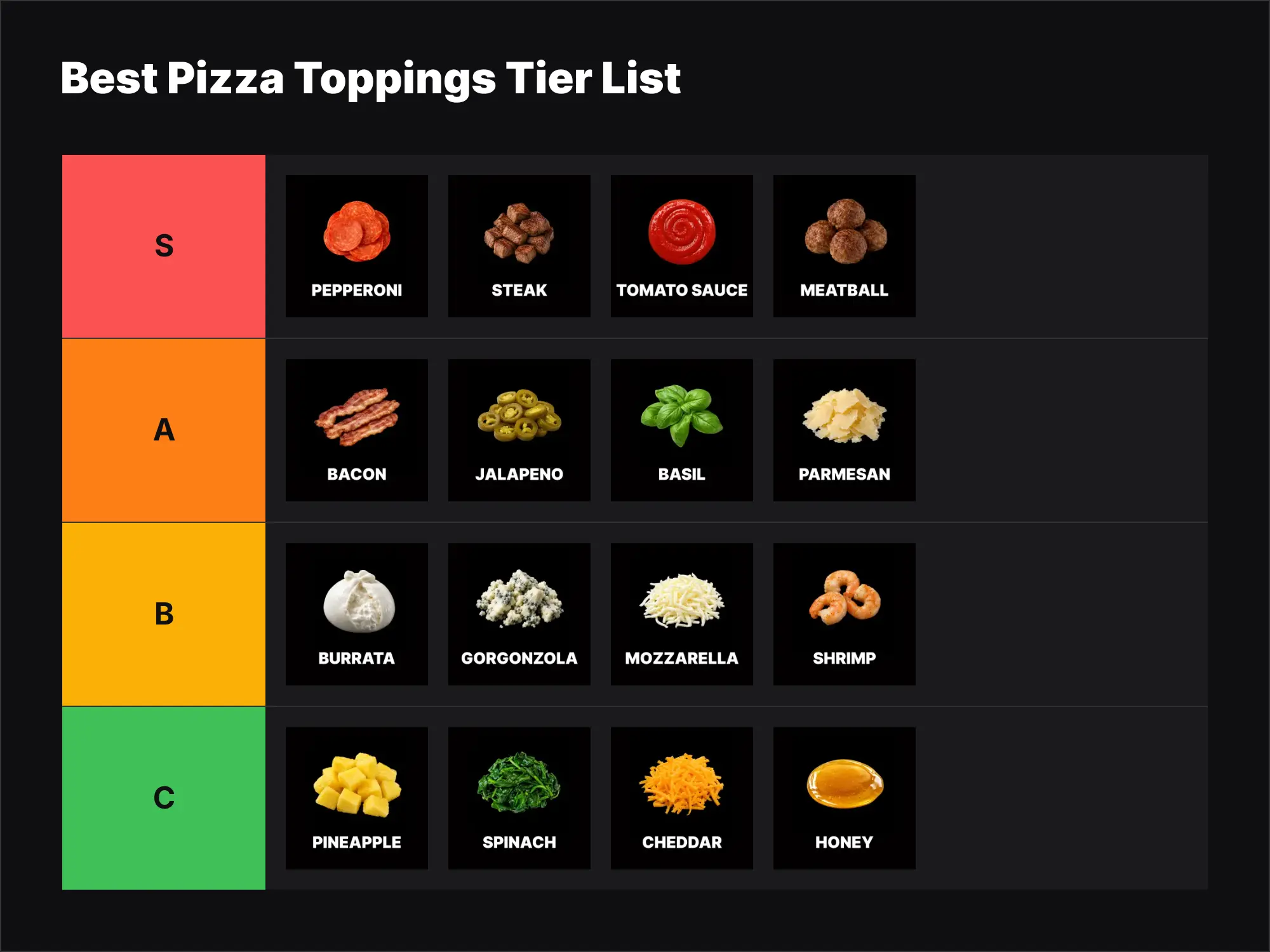
The format expanded beyond gaming when YouTube and Twitch turned tier lists into content. In 2019, a viral fast food tier list by iDubbbz pulled the format into mainstream pop culture, and the S/A/B/C structure came with it. People who had never played a competitive game in their lives started placing movies, snacks, and random preferences into the same rows that Capcom had been using for mission grades.
S tier arrived in tier lists pre-loaded with meaning. It didn't need to be explained because games had spent two decades teaching players what it meant.
Why not just use A+?
It comes up sometimes. A+ works fine in school, but it gets awkward in rankings.
Once you have A, A+, and A++, the labels start competing with each other. S sidesteps that entirely. It's a different letter, visually distinct, and it carries a shared cultural understanding of "above the normal top." Tier lists are meant to be scanned quickly, and S communicates its position at a glance.
There's also something in the sound. "S rank" has a punch to it that "A-plus" doesn't. Part of why the format stuck is that it just felt right to say.
What S tier actually means today
S rank started as a Japanese academic distinction for work beyond the top grade. Games adopted it to reward exceptional performance. Competitive communities inherited it when they built tier lists. The internet spread it everywhere else.
Today it's shorthand for "above the rest," applied to anything from fighting game characters to TV shows to sandwiches. The grading system that once lived in university transcripts is now how the internet talks about what's worth your time.